

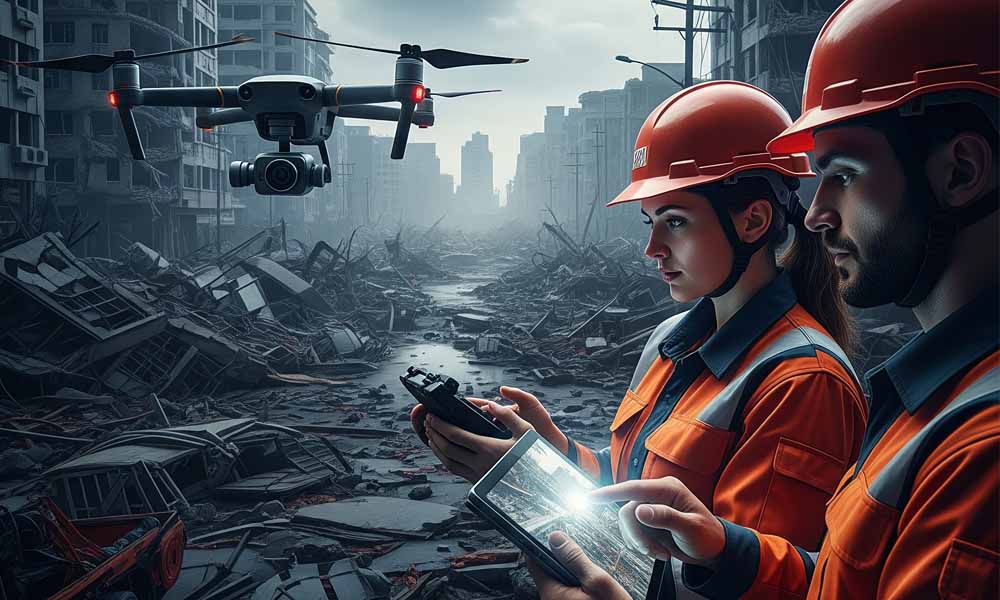
Deploying Drones, Robotics & AI to Support Emergency Response and Save Lives
Disaster Tech Response
The Federation of Aerospace Engineers and Robotics Innovations (FAERI) is committed to using technology for humanity. Our Disaster Tech Response Program brings together the power of drones, robotics, artificial intelligence (AI), and remote sensing to support government agencies, rescue teams, and communities during natural disasters, humanitarian emergencies, and crisis situations.
With India facing increasing incidents of floods, landslides, forest fires, and urban disasters, timely and accurate technological intervention can make a critical difference. FAERI's trained response teams and indigenous technologies are built to operate in extreme and unpredictable environments — enhancing safety, coordination, and recovery.
What We Offer in Disaster Tech Support
Our specialized solutions are designed to work hand-in-hand with Disaster Management Authorities, Fire & Rescue Services, Police, Forest, and Health Departments. Core services include:
Aerial Surveillance & Mapping
- Use of drones for real-time aerial view of flood-affected or inaccessible areas
- Creation of high-resolution maps for rescue and relief planning
- Detection of collapsed structures, water bodies, and escape paths
Search & Rescue Operations
- Deployment of drones with thermal cameras and AI-based object detection
- Night-time operations using IR and low-light vision systems
- Ground robot support for debris search and narrow-space access
Disaster Preparedness & Simulations
- Tech-based disaster mock drills with departments and communities
- Risk-mapping through aerial and terrain data analysis
- Integration of drones into standard operating procedures (SOPs)
Communication and Coordination
- Drones with portable communication relays in network-dead zones
- Real-time data streaming to command centers during emergencies
- Decision support systems using AI-powered dashboards
Post-Disaster Assessment
- Aerial damage analysis and loss documentation for relief disbursement
- Environmental monitoring (e.g. landslide risk, dam safety, coastal erosion)
- Archival drone data for policy planning and insurance use
Who We Work With
Our technologies and support systems are used by:
- State Disaster Management Authorities (SDMA/NDMA)
- Fire and Rescue Departments
- Police, Forest, and Coastal Guard Forces
- Health and Emergency Medical Teams
- NGOs and Government Relief Agencies
FAERI has trained drone operators and engineers with disaster-site deployment experience, ensuring safety, accuracy, and efficiency.
Key Impact Areas
- Rapid Response and Improved Situational Awareness
- Increased Safety for Rescue Personnel
- Faster Recovery with Accurate Data and Analysis
- Integration of Indigenous Tech into Disaster SOPs
- Community Preparedness and Resilience Building
Why Technology Matters in Disaster Response
India's geography exposes communities to a wide range of hazards — monsoon floods in Kerala and the northeast, landslides in hilly terrain, forest fires, cyclones along the coast, and dense-urban incidents in growing cities. In the first hours of any emergency, decision-makers face a shortage of reliable information: which roads are passable, where people are stranded, and how badly structures are damaged. FAERI's Disaster Tech Response approach is built to close this information gap quickly, so that rescue and relief resources are directed to where they are needed most.
Unlike conventional ground surveys, drones and remote-sensing systems can cover large or unreachable areas in minutes, feed live imagery to a command centre, and operate at night or through smoke using thermal and low-light sensors. Combined with AI-assisted analysis, this turns raw aerial footage into actionable insight — flagging probable survivor locations, mapping flood extent, and prioritising damaged zones. The goal is never to replace responders, but to make every responder safer, faster, and better informed.
FAERI's Role: Training, Technology and Field Support
FAERI works at the intersection of aerospace engineering, robotics and public service. As a federation of engineers and innovators, we focus on three things: building and adapting indigenous drone and robotics technology suited to Indian disaster conditions; training drone operators, engineers and emergency personnel to deploy these tools safely and lawfully; and supporting agencies in the field during drills and real incidents. Our emphasis on home-grown technology helps reduce dependence on imported systems and keeps solutions affordable and serviceable.
We believe preparedness is as important as response. That is why FAERI promotes integrating drones and data tools into the standard operating procedures of disaster-management bodies, running joint mock drills, and sharing knowledge with students, clubs and institutions so that the next generation of responders is technology-ready. Through workshops, research projects and community programmes, FAERI helps build long-term resilience rather than one-time interventions.
Frequently Asked Questions
How are drones used in disaster response?
Drones provide rapid aerial surveillance, high-resolution mapping of affected areas, and search-and-rescue support using thermal and low-light cameras. They can reach flooded, collapsed or otherwise inaccessible zones safely, stream live video to command centres, and help assess damage for faster, better-targeted relief.
What technologies does FAERI use for disaster tech response?
FAERI combines unmanned aerial vehicles (UAVs/drones), ground robots, AI-based image and object detection, remote sensing, and portable communication relays. These are paired with data dashboards and mapping tools to give responders real-time situational awareness during emergencies.
Does FAERI work directly with government and rescue agencies?
Yes. FAERI's solutions are designed to support agencies such as State and National Disaster Management Authorities, Fire and Rescue Services, Police, Forest and Coastal forces, health and emergency medical teams, and government relief agencies and NGOs, working alongside them rather than independently.
Can drones help with search and rescue at night?
Yes. Drones fitted with infrared (IR), thermal-imaging and low-light vision systems can detect heat signatures and operate in darkness or low-visibility conditions, helping locate survivors when ground search would be slow or unsafe.
How does FAERI support disaster preparedness, not just response?
FAERI conducts technology-based mock drills, risk and terrain mapping, and helps integrate drones into official standard operating procedures. It also trains operators and engineers and runs awareness and skill programmes that build community resilience before disasters strike.
Is FAERI's disaster technology developed in India?
FAERI prioritises indigenous, India-built technology that is adapted to local disaster conditions. This focus on home-grown solutions keeps systems affordable, serviceable and aligned with national capability-building goals.
Be part of India’s aerospace & robotics movement
Join FAERI as a member, or talk to our team about collaborating on this program.